
Click to listen to audio commentary
General information
| Address | No. 264 Hai Thuong Lan Ong Street, Ward 14, District 5, Ho Chi Minh City |
| Opening hours | 6:15 am – 5:00 pm daily |
| Level of Monument | Architectural and Artistic at national level in 1998 |
General introduction
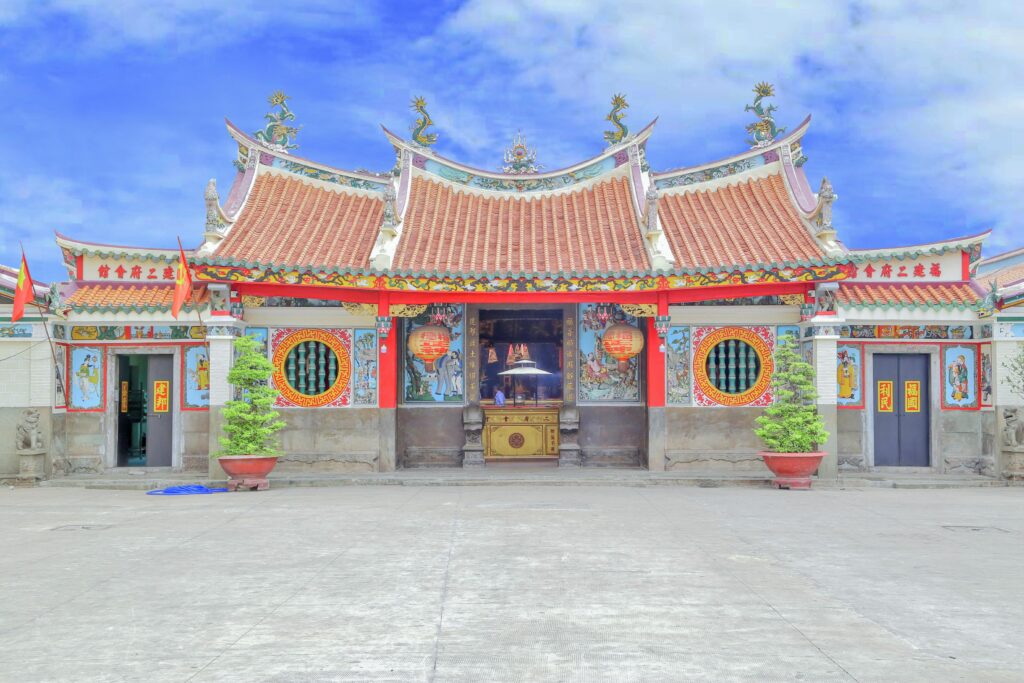
Nhi Phu Guild-hall (also known as Nhi Phu Temple or Ong Bon Pagoda) is currently located at 264 Hai Thuong Lan Ong Street, Ward 14, District 5, Ho Chi Minh City. There was recognized by the Ministry of Culture and Information as the Relic of Architectural and Artistic at national level in 1998.
The Guild-hall was built in a prime location on the shore of Cho Lon canal, of which was ground-filled then named as Khong Tu Street, now Hai Thuong Lan Ong Street. Not far from the Guild-hall was Pho Xep canal, which was then became Tong Doc Phuong Street then now Chau Van Liem Street. Nearby was a central market, now the Cho Lon Post Office.
In the end of the 18th century, immigrants from Tuyen Chau and Chuong Chau Prefectures (Districts), which had built the On Lang Guilld-Hall and the Ha Chuong Guild-Hall separately, built a temple to worship Bon Dau Cong and named Nhi Phu Temple, commonly known as Ong Bon Pagoda.
In 1871, the colonial government had adjusted the previous states into five states, then Nhi Phu Temple became Nhi Phu Guild-Hall of the Fujian community.
The Guild-Hall campus is more than 2,500 m2 wide, the yard has more than 1/3 of the campus with a new three-door gate was built in 1990. At the right of the Guild-Hall is Tran Boi Co middle-school, which was formerly Fujian middle-school that had been built by Nhi Phu Guild-Hall.
Nhi Phu Temple was the architectural work, which not only had high religious value, but also had architectural and artistic research value. The architectural and sophisticated carvings system contributed to make the unique and outstanding temple. Decorative motifs represented many different themes, generally expressing the thoughts and wishes of the people to the Gods, hoping for whose blessings; thereby, expressing the spiritual life and culture of the Fujian people.
The overall architecture of Nhi Phu Temple was quite simple but shows uniqueness and sophistication, affirming the pinnacle level of artistic. The temple was built in according to the typical Chinese structural system, with the form of “Stackable wooden beams – Dougoung System” making its roof slightly curved like a dragon boat. However, the temple roof had a small slope, which was typical of Chinese temples in Ho Chi Minh City. The “con-son” were created in beautiful curved shapes. The head of the purlins and the horizontal bars, the wooden brackets, etc. were also exquisitely carved.
On both sides of the three-step stairs leading to the Guild-hall were a pair of stone Qilin statues made in the year of Mau Dan, Quang Tu era, in 1878. The “tan hi cau” statue is placed on the left. On the right was “Lan Giao Tu” statue, carved in the shape of the mother qilin using its front legs to hug across the back of the baby qilin, the baby quilin took its head up then pressed its belly against its mother’s chest. This carving was flexible and funny.
The front wall of the Guild-hall was made of stone slabs, embossed with reliefs of dragons, tigers, fairies, etc. On both sides of the threshold were two stone balls. The stone pedestal supporting these stone balls was embossed with flowers, leaves, wine gourds, and poetry “bags”. Above the door were carved four large Chinese characters “Nhi Phu Guild-Hall”.
In addition to the main door, there were two sub-doors designed opposite each other on both sides of the main door. On the two wooden doors leading to the front hall were painted of two Than Mon (Gate Guardian Gods).
The interior of Nhi Phu GuildHall was majestic with rows of tall columns, one of which was 7 meters high, each column had one or two couplets hanging, some of which were curved along the column body, most of which were embossed with Chinese characters on a background of the wooden surface. There were 14 pairs of two-couplets dating from 1895 to 1901 and 28 horizontal lacquered boards dating from 1864 to 1901. In addition to the calligraphic value of these horizontal lacquered boards and two-couplets, there were also unique wood carvings, demonstrating the wood carving art of Gia Dinh in the late 19th century.
Next to the front hall was the Skylight courtyard. From Skylight cross the left corridor to the shrine of Chu Sinh Nuong Nuong God, which of the goddess who protects pregnancy and childbirth. Her statue was made of plaster, depicting a kind woman wearing a red cloak, holding a calligraphy-pen. Above her altar, there was carved with reliefs on the front, hangs a horizontal lacquered board “Pho te chung sinh” (Blessings for all living beings) which was made in 1991. To the right of the shrine of the Chua Sinh Nuong Nuong God, there was also the shrine of the Great Sage Equaling Heaven (Monkey King), who was a character in the story Journey to the West.
Opposite to the shrine of the Chu Sinh Nuong Nuong, on the right side of the Skylight, there was the shrine to Quan Thanh De Quan, known as Quan Cong, with being flanked by Quan Binh and Chu Thuong standing to attend.
Across the Skylight was the main hall, which was the most solemn part of the Guild-Hall. In front of the main hall, there was a large incense burner. Under the roof of the main hall, there was hung a horizontal lacquered board “Than lam phuc dia” (God arrives in the blessed land) and three panels with carved pine-crane, flower vines, etc.
In the middle of the main hall, there was an incense altar, on the front of which was a relief “Luc quoc phong tuong”. Alongside this altar, on the left wall, there was a large pink bell, symmetrical with the drum stand placed on the right wall of the main hall. The end of the main hall was displayed with three shrines decorated with carved panels with peony and pheasant motifs, made in 1895.
The shrine of Bon Dau Cong had the central position with a large altar on which was displayed a set of incense burners and two unique vases. The front of this altar was decorated with reliefs from Chinese legendary stories. Above that was a horizontal lacquered board “Ngo tho dia da” (This land belongs to us) made in 1864. Separating this altar from the altar of Bon Dau Cong were two screens attached to the two middle-pillars of the main hall. These screens are almost as high as the pillars, carved with apricot blossoms – bird, blossom – butterflies, etc.
The altar of Bon Dau Cong was more than three meters high and about two meters wide. The top of the altar was carved with “Two dragons fighting for a fire-pearl”, on both sides of the front, each side had five symmetrical layers of panels, carved with pine – crane, apricot blossoms – birds, corns – plains – phoenixes… interspersed with the Chinese pattern of Coin, the Chinese pattern of “Longevity”. Below the altar, there were three embossed reliefs preserved in a glass box. The middle relief was animals from the river such as shrimp, crabs, storks pecking at fish… carved delicately and vividly. The two reliefs on both sides were embossed Chinese legendary stories. The decorations around this altar were all painted with gold to create a splendid and magnificent look. The wooden statue of Chau Dat Quan depicted an old man with a gentle face and a white beard, wearing a crown, sitting on a throne, with two boys standing to attend in front of him.
The left shrine was Quang Trach Ton Vuong, there was simply decorated. The altar was about 2 meters high, about 1.5 meters wide, carved with images of Two Dragons facing The Sun, pine – deer, flower vines… Quang Trach Ton Vuong or Pho Quang King was originally from Fujian. According to legend, he had the miracle of saving Fujian people on their migration and blessing them with prosperity. The wooden statue of Quang Trach Ton Vuong was depicted a young man sitting on a throne. In front of the statue of Quang Trach Ton Vuong was a statue of the Phat Duoc Su.
The shrine and altar of Thai Tue Gia Gia on the right side were decorated similar to the shrine and altar of Quang Trach Ton Vuong. Thai Tue Gia Gia was the God who controlled the years, months, and age of a person’s life. Every year, Thai Tue would choose a god corresponding to the zodiac animal of that year to rule, bestowing age and health to everyone. The statue of Thai Tue Gia Gia was shaped like an old man with white hair and beard, surrounded by 5 statues of White Tiger, the god who can protection and drive away bad influences.
The back of the temple was separated from the front temples by a large skylight courtyard with a fish pond and many ornamental plants. The back of the temple was built on a foundation about one meter high. There were three large incense burners in front. There were three shrines that were decorated with embossed panels and curtains.
The altar of the Jade Emperor; The shrine of Shakyamuni Buddha on the left with the Buddha’s statue sitting on a lotus throne; The shrine of Quan Am Bodhisattva on the right with the Bodhisattva’s statue sitting on a lotus throne.
Every year, according to the lunar calendar, Nhi Phu Guild-Hall has many worship days that attract many people to come and worship. The two main days of worship are the birthday and death of Ong Bon on the 15th day of the first lunar month and the 15th day of the eighth lunar month.
In addition to being the only place to worship Bon Dau Cong in the area, Nhi Phu Guild-Hall is the unique architectural relic with aristic of sophisticated wood carvings, there is also a relic about the settlement and integration period of the Fujian Chinese people.

