Tap to listen to the audio guide
General information
| Address | No. 12 Lao Tu Street, Ward 11, District 5, Ho Chi Minh City |
| Opening hours | 6:15 am – 5:00 pm daily |
| Level of Monument | National Architectural and Artistic Relic (recognized in 2002) |
Introduction to the Relic
On Lang Guide Hall, also known as On Lang Pagoda, Quan Am Pagoda, or Ong Lao Pagoda, is located at No. 12 Lao Tu Street, Ward 11, District 5, Ho Chi Minh City.
The Guide Hall has been renovated six times (1828, 1867, 1897, 1993, 1995 and 2017). In 2002, it was recognized as a National Architectural and Artistic Relic by the Ministry of Culture and Information under Decision No. 39/2002/QD-BVHTT dated December 30, 2002.
Historically, the hall’s establishment and development are tied to the migration and settlement of the Quanzhou (Tuyen Chau) people. Today, it attracts not only Fujianese descendants but also domestic and international visitors who come to express their faith in the deities and admire its historical and cultural significance in old Saigon.
Unique Architectural and Cultural Features of Old Saigon – Cho Lon
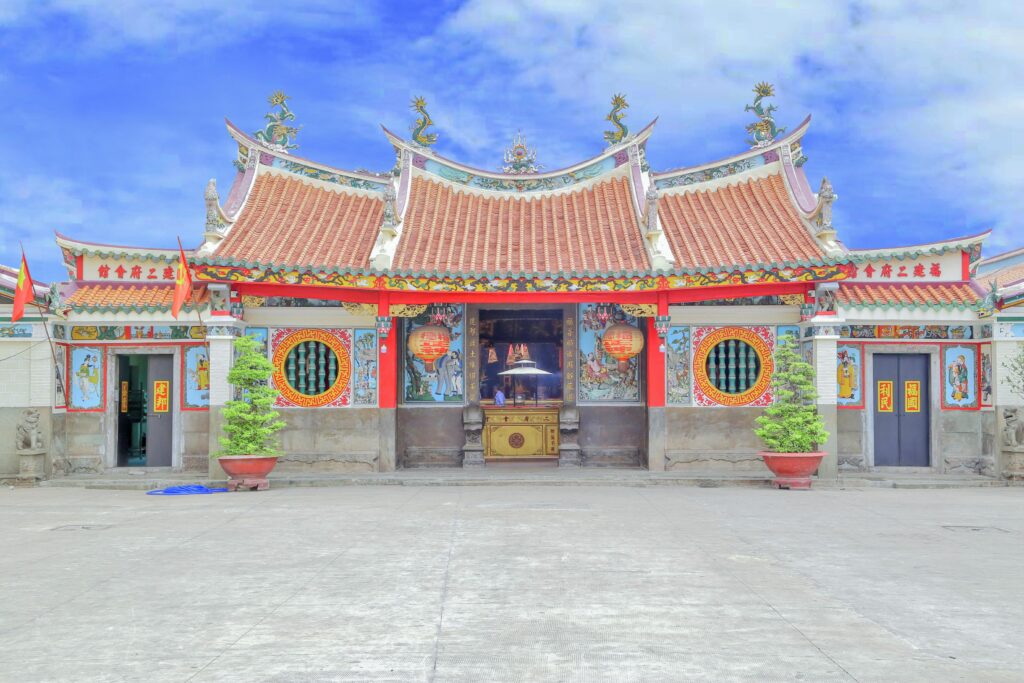
The Guide Hall spans 1,800m², roofing with its tube-tiles and bordering roof-edge with its lapis-tiles. In particular, the roof was shaped and decorated by the espcially architectural Fujianese with curved ridge-eaves, curved blade attached to citadel-architecture by colorful ceramic.
The Guide Hall’s campus included of a small courtyard in front, a fish pond across the street in front of the Guide Hall, a rectangular block in the middle (including: front hall, middle hall, main hall) and three perpendicular rows of houses forming U-Shape, separated the central block by walkways.
The front hall starts from two sides of the main threshold, with a pair of stone Qilins that were donated in 1869. Above the door frame is a Chinese plaque “On Lang Hoi Quan” (“On Lang Guide Hall”) carved into the façade wall. The parallel sentences carved into the doorposts were given to The Guide Hall by a Chinese scholar when he visited in 1901:
“ÔN nhu tức chí nhân, thánh đạo thiên dân nguyên Khổng Dịch,
LĂNG nhạc đồng trang trọng, mẫu nghi hình ngã cánh vô phương”
(Gentle, elegant, by the way of the holy Confucius teachings people,
Solemn, disciplined Temple of the holy Mother blesses everywhere).

The front wall features wooden reliefs and raised reliefs depicting the Four Heavenly Kings. The architecture under the eaves is elaborately decorated with lotus flowers that was carved inverted at the head of the purlin, wooden Qilin statues, floral vines painting gilded-vermillion on the horizontal bars. No altar in the front hall but only a rectangular high-shelf and a large ceramic incensory. In the left corner of the front hall is a large bronze bell molded in Foshan, Guangdong, China, in 1885.
The middle hall was dedicated to the worship of the Jade Emperor, with an altar on which was a statue of the Jade Emperor and two statues of Nam Tao and Bac Dau. Along both sides of the middle hall were full-blown two reliefs of Green Dragon (Thanh Long) and White Tiger (Bach Ho) on the walls.
The Middle Hall is dedicated to the Jade Emperor, with an incense altar bearing his statue and two statues of Nam Tào and Bắc Đẩu (the Star Gods of Longevity). Along the sides of the Middle Hall are raised reliefs of the Azure Dragon and White Tiger on the walls.
The main hall is the altar of The Empress of Heaven God (Thien Hau Thanh Mau), a Goddess from Fujianese who often helps people at sea. On the left and right were the altar of the Goddess of Child Birth (Chua Sinh Nuong Nuong) and The God of Land’s altar (Phuc Duc Chinh Than). Each altar was decorated with elaborately carved panels. The altar of Thien Hau Thanh Mau also had two screens on both sides, bring to the solemnity.
The altar of Thien Hau Thanh Mau, which was about 2.5 meters in height, was made in 1867, there was carved with “Two dragons facing the moon”, Couple of Phoenixes, Pines – Cranes… Thien Hau Thanh Mau was shaped like a kind lady wearing a brocade robe with two women standing on two sides to attend. At the feet of Thien Hau Thanh Mau is a ancestral tablet inscribed in Chinese characters “Appoint to Nation-Protector Ti Dan Thien Thai Hau Nguyen Quan”. A little lower below of Thien Hau Thanh Mau’s feet was two statues of Thien Ly Nhan god (who could see a thousand miles range) and Thuan Phong Nhi god (who could hear a thousand miles range).
The altar of the Goddess of Child Birth and The God of Land were both dated on 1897, each about 2 meters height and similarly carved with themes of Two Dragons fighting for a Fire-Pearl, Couple of Phoenixes, Bamboo and Birds, Lotus … In addition to the statue of the Goddess of Child Birth, the altar also had many statues of the Midwives caring for and holding children. The God of Land’s altar displays two sets of statues of Mr Bon and his assistants.
At the rear of the main hall, there are two doors leading to the frontyard of the back hall. In this courtyard is an altar dedicated to Quan Am Bodhisattva arranged with its back against the wall of the main hall, facing the back hall. The statue of Quan Am Bodhisattva was nearly 2 meters height, standing on a lotus throne, holding a bottle of holy water to save sentient beings, attended two sides by the statues of Kim Dong and Ngoc Nu.
The back hall was decorated with a row of seven altars, which was displayed in the same. Above each altar was hung a horizontal-lacquered board praising the merits of the Gods. The altar of Quan Am Bodhisattva was placed in the middle with a statue of Quan Am sitting on a lotus throne. On the left there were the altar of Quan De and Bao Cong. The statue of Quan De was a red-faced General with Quan Binh and Chau Xuong attending him, while Bao Cong is a black-faced Mandarin sitting on a throne, and the altar of Quang Trach Ton Vuong.
On Lang Guide Hall has many altars, and thus the number of worship statues was greater than other guide halls. In addition to the altar, incensories and door panels that were delicately carved by methods of penetrated, sunken, and gilded techniques; On Lang Guide Hall also had 23 horizontal-lacquered boards from 1826 to 1908 and 16 pairs of parallel sentences from 1841 to 1901. Most of these were donated by other guide hall such as Quynh Phu, Tue Thanh, Ha Chuong, Nhi Phu… on the occasion of restoration.
The attracting value of experiential tourism
The ancient and long-period Quan Am Pagoda is one of the famous spiritual tourist destinations in Saigon. This destination is ideal for people come to worship, dedicate incense and spend moments of relaxation and peace in front of Buddha. Having come here, all the worries on your shoulders seem to disappear and be left behind. If you would have come in bustling Saigon, please should try to visit On Lang Guide Hall – Quan Am Pagoda.